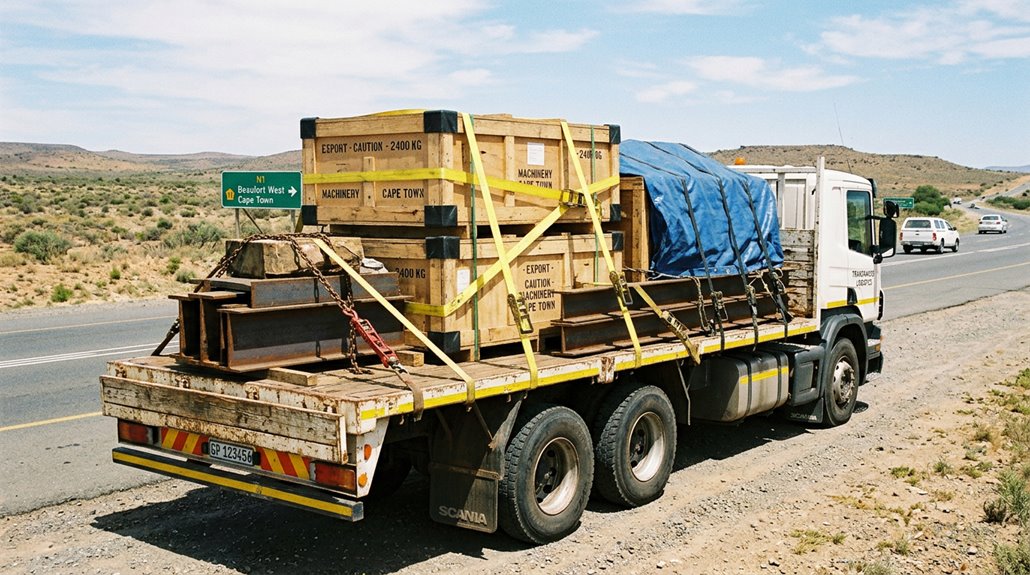
Hit the brakes hard at 80 km/h with 30 tonnes on the deck and your load wants to keep going, pushing towards your cab with a force of roughly 24 tonnes. Whether it stays put comes down to a few straps, some chains and the ten minutes you spent before you pulled out.
This guide covers load securing (also called load restraint or cargo securing) the way South African drivers and fleet owners actually need it: what the law says, the simple physics behind it, which equipment to use for which load, and a checklist you can run through before every trip. No jargon you don’t need, no theory you can’t use.
⚡ The short answer
South African law (Regulation 246 of the National Road Traffic Regulations) says goods on a vehicle must be safely contained in the body or securely fastened to it, and protected from shifting, falling or spilling. In practice that means: plan the load, block it against the headboard where you can, use rated straps or chains for the rest, cover loose material, and check everything again after the first stretch and at every stop.
Why load securing matters more than you think
A shifting load doesn’t just damage freight. It changes how the truck brakes, steers and corners, and it can tip a combination over on a bend you’ve driven a hundred times. The European Commission has estimated that up to 25% of accidents involving trucks can be linked to inadequate cargo securing, and its European Best Practice Guidelines on Cargo Securing for Road Transport remain one of the most thorough free references on the subject.
Then there’s the money. A load that ends up on the road means damaged goods, a recovery bill, possible fines and, often worst of all, an insurance claim that gets questioned. On roads like the N2, with heavy timber, coal and cross-border traffic, potholes and long downhill sections, a load that “seemed fine at the depot” gets tested every few kilometres. Our guide to avoiding common road hazards on the N2 explains what your load (and your suspension) is up against.
What South African law says about securing a load
There isn’t a thick, separate “load securing act” in South Africa. The rules sit in the National Road Traffic Act 93 of 1996 and its regulations, and they’re short but clear.
Regulation 246: how goods must be carried
Regulation 246 says no person may operate a vehicle on a public road carrying goods unless:
- the goods are safely contained within the body of the vehicle, or securely fastened to it;
- they’re properly protected from being dislodged or spilled;
- the load doesn’t touch the road surface or block the driver’s view;
- containers with twist-lock fittings are locked with those twist locks.
Notice the words “no person”. That includes the driver, not just the company.
The operator, the consignor and the paperwork
Section 49 of the Act makes the operator responsible for running the vehicle with due care and taking reasonable steps to make sure it’s loaded and operated within the rules. Regulations 330A to 330D add duties for the consignor and consignee (the people sending and receiving the goods), including a declaration of the nature and quantity of the goods carried in the vehicle. Focus on Transport’s legal column “A heavy load” unpacks these duties and the insurance angle well. For the wider rulebook on mass, dimensions and driver duties, see our plain-English guide to South African road regulations for truck drivers.
There’s also a national standard, SANS 10187-1, which sets out the safety problems and basic precautions for securing loads on vehicles. It’s a paid standard, but fleet safety managers should have a copy.
💸 The insurance trap: Goods-in-transit insurers can treat a breach of the Road Traffic Act as misconduct, and poor securing or packaging can be grounds to reject a claim. A two-minute strap check is a lot cheaper than an argument with an underwriter.
This section is a plain-language summary to help you stay safe and legal. It isn’t legal advice.
How hard your load really pushes (the physics, minus the headache)
Load securing standards such as EN 12195-1, the European standard widely used to calculate load restraint, design restraints to hold these forces:
- Forward: 0.8 × the load’s weight (hard braking)
- Sideways: 0.5 × the load’s weight (cornering and swerving)
- Backwards: 0.5 × the load’s weight (pulling away, reversing, bumps)
Here’s what that looks like in tonnes:
| Load weight | Forward (braking) | Sideways (cornering) | Backwards |
|---|---|---|---|
| 5 t | 4 t | 2.5 t | 2.5 t |
| 10 t | 8 t | 5 t | 5 t |
| 20 t | 16 t | 10 t | 10 t |
| 30 t | 24 t | 15 t | 15 t |
🤓 Why “it’s too heavy to move” is a myth: Friction depends on the load pressing down on the deck. Every bump, pothole and vibration briefly lightens that pressure, and that’s exactly when a “heavy” load slides. Heavy loads don’t stay put on their own. They just do more damage when they move.
The three ways to secure a load
Every good load restraint plan uses one or more of these methods. Most real loads use a combination.
1. Blocking (the load can’t go anywhere)
The load sits tight against something solid: the headboard, side walls, stanchions, chocks or other cargo, with no gaps. Fill gaps with dunnage, timber bracing or airbags. Blocking is the most efficient method because the vehicle’s structure takes the force, not your straps. The catch: the headboard or body has to be strong enough for the load.
2. Direct lashing (the strap or chain holds the force)
A chain or strap runs from a lashing point on the load straight to an anchor point on the vehicle. The lashing’s rated lashing capacity (LC) does the work. This is the go-to for machinery, plant, steel and anything with proper lashing eyes. Work in pairs, pulling in opposite directions, and keep angles sensible: a lashing that runs almost straight up holds very little forwards or sideways.
3. Top-over lashing (the strap clamps the load down)
Straps go over the top of the load and press it onto the deck, increasing friction. Here the number that matters is the strap’s standard tension force (STF) on the label, not the big LC figure. Top-over lashing works best on loads that are already blocked forwards, and it gets dramatically more effective with anti-slip mats under the load.
Load securing equipment, explained
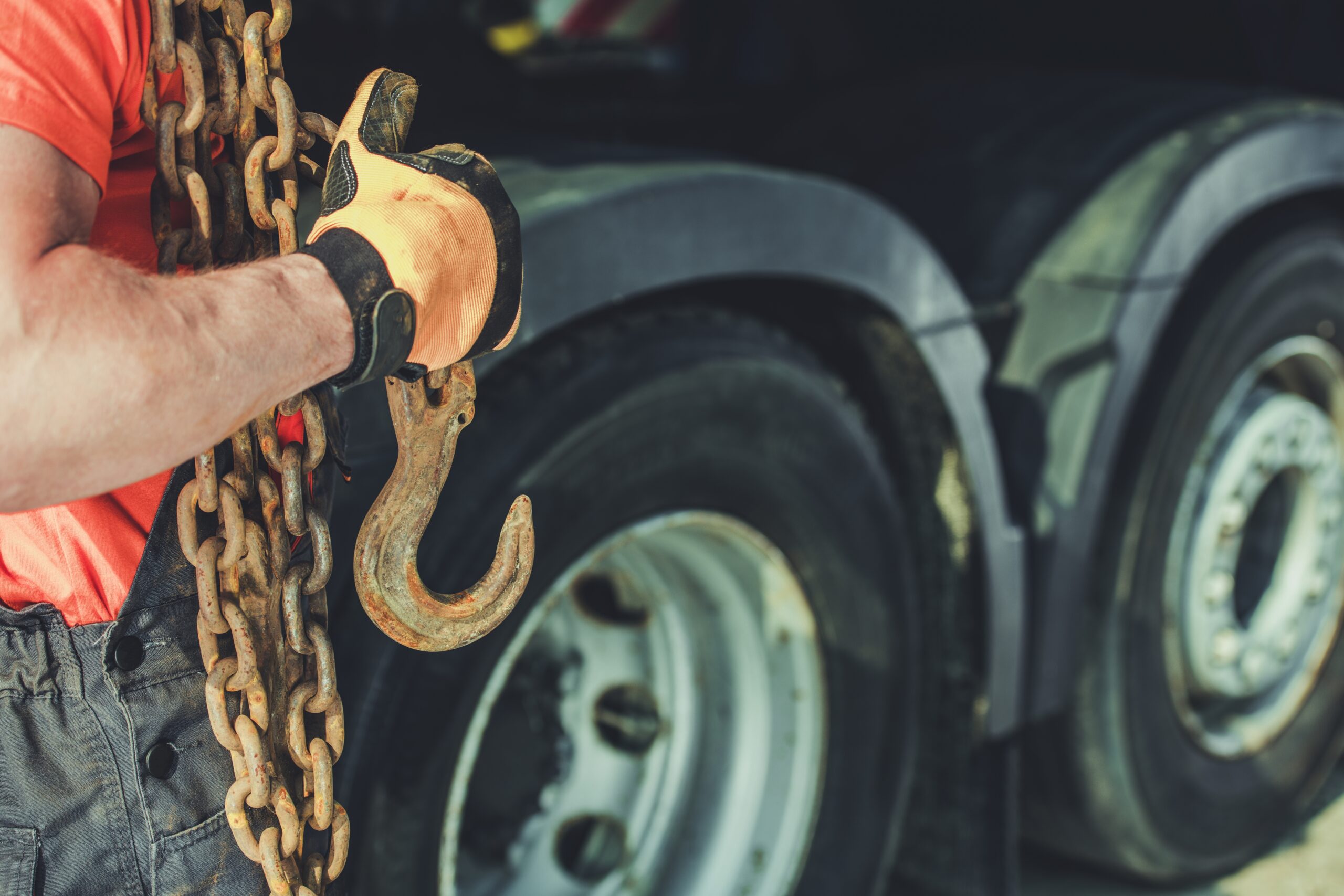
The right load securing equipment depends on the cargo, the body type and the method you’re using. Here’s a quick guide to the kit you’ll see on South African trucks, and what to check every time you use it.
| Equipment | Best for | Check before every trip |
|---|---|---|
| Ratchet straps (web lashings) | Pallets, crates, timber packs, top-over lashing | Readable label (LC and STF), no cuts, burns or broken stitching |
| Chains & load binders | Machinery, plant, steel, heavy direct lashing | No stretched, cracked or twisted links; hooks not opened up |
| Anti-slip mats | Any load on a smooth or wet deck | Clean, dry and untorn, with the load fully on the mat |
| Edge protectors | Sharp, soft or easily crushed loads | Fitted wherever a strap touches an edge |
| Dunnage, chocks & airbags | Filling gaps; wheeled, round or rolling loads | Tight fit, no splits, chocks nailed or locked where needed |
| Nets & tarpaulins | Coal, sand, wood chips, refuse and other loose bulk | No holes; tied down along the full length |
| Twist locks | ISO containers | All four engaged and locked (required by Regulation 246) |
| Stanchions & headboard | Timber, poles, pipes and long loads | No cracks, bends or missing pins |
💡 Driver tip: Don’t mix chains and straps to restrain the same load in the same direction. They stretch differently, so the stiffer one takes almost all the force and can fail while the other is still slack.
How to secure common South African loads
🌲 Timber and logs
Around Mkhondo, timber is king. Each stack needs stanchions on both sides, a strong headboard and lashings over the top that pull the logs together. Short logs that only reach one pair of stanchions are the classic danger: stanchions keep logs from rolling off the side, but only lashings stop them sliding forwards. Re-tension after the first stretch, because bark compresses and loads settle.
⛏️ Coal, sand and other loose bulk (side tippers)
Regulation 246 specifically mentions goods being spilled. Don’t load above the sides, check that tipping gates and locks are closed and latched, and cover the load with a tarp or net tied down along its full length. Wind gets under a loose tarp fast. Our tips for driving in bad weather on the N2 explain why the Highveld wind deserves respect.
📦 Palletised and boxed freight
Load tight against the headboard, keep heavy items low and centred, and fill gaps. Use anti-slip mats and top-over straps on every row. On curtainsiders, remember the curtain usually isn’t load restraint unless the body is specifically rated and certified for it. Treat it as weather protection, not a wall.
🚜 Machinery and plant on lowbeds
Use direct lashing with chains at four or more points, pulling in opposite directions, with the park brake on, wheels or tracks chocked, and buckets, booms and attachments lowered and secured on their own. Check machine lashing points are rated for the job, not just a handy-looking bracket.
🚢 Containers
Twist locks on all four corners, engaged and locked. If the container sits on a vehicle without twist locks, it needs another approved way of securing it.
Your load securing checklist
Screenshot this, print it for the cab, or share it with your loaders. It pairs well with our guide to regular vehicle checks for truck drivers.
Before loading
- Deck clean, dry and free of oil or gravel
- Anchor points, headboard and stanchions undamaged
- You know the load’s weight and where its centre of gravity is
- Enough rated straps, chains, mats and edge protectors
Before you drive off
- Load against the headboard, with no gaps
- Weight spread so no axle is over its limit
- Every lashing tensioned, edges protected
- Loose strap ends tied up, gates and doors locked
- Tarp or net secured, load declaration in the cab
On the road
- Re-check after the first 30–50 km (loads settle)
- Check at every stop, refuel or rest break
- Check after harsh braking, rough roads or heavy rain
- Listen for flapping, banging or creaking: stop and look
Checking straps in the dark on a road shoulder is nobody’s idea of fun, or safety. Pull into a lit, guarded yard instead: our 24/7 secure truck parking in Piet Retief gives you room to walk round the whole rig, re-tension and grab a coffee, at any hour. And if a long day is catching up with you, read our advice on fatigue management for truck drivers. Tired eyes miss frayed straps.
When to bin a strap or chain
Load securing equipment wears out, and it rarely fails politely. The UK’s official code of practice on securing loads is a useful reference here. Take equipment out of service if you find:
- Straps: a missing or unreadable label, cuts, tears, burns, heavy abrasion, damaged stitching, chemical damage, or a bent or cracked ratchet.
- Chains: stretched, cracked, bent or twisted links, worn or opened hooks, or a load binder that’s bent or won’t lock.
- Anything that has been through a crash or a load shift, or that you simply can’t vouch for.
A new ratchet strap costs less than one damaged pallet. Keep a few spares in the cab.
7 load securing mistakes that get loads (and people) hurt
- Trusting weight and friction alone. “It’s heavy, it won’t move” is how loads end up in ditches.
- Using a cheater bar. Extension bars on load binders (“dogs”) or ratchets cause serious injuries when they slip or spring back, as Workplace Health and Safety Queensland warns in its guide to safe handling when securing loads. If you need more force, you need better gear.
- Leaving gaps. A load that can build up speed before it hits the headboard hits much harder.
- Running straps over sharp edges. No edge protector means a strap that’s already halfway to failing.
- Treating curtains and tarps as restraint. They keep the weather out, not the load in.
- Too few lashings. If you haven’t worked it out with the strap’s rating and the load’s weight, you’re guessing.
- Never re-checking. Straps loosen as loads settle. The first 50 km is when it happens most.
Want the bigger picture on staying safe out there? Our 10 road safety tips for long-haul truck drivers cover the rest of the trip.
Re-check your load on the N2 at Piet Retief
Open 24/7 on the N2 in Mkhondo: a lit, guarded yard to walk round your rig, hot showers, a canteen next to the parking, and truck tyre repairs on site if something else needs attention.
Load securing FAQ
What is load securing?
Load securing (also called load restraint or cargo securing) means stopping cargo from sliding, tipping, rolling, falling or spilling while the vehicle moves. It’s done by blocking the load against the vehicle’s structure, lashing it with rated straps or chains, or a combination of both.
What does South African law say about securing a load?
Regulation 246 of the National Road Traffic Regulations says no person may operate a vehicle on a public road carrying goods that aren’t safely contained within the body or securely fastened to it and protected from being dislodged or spilled. Containers with twist-lock fittings must be locked with them.
Who is responsible for securing the load: the driver or the company?
Both. Regulation 246 applies to any person operating the vehicle, so the driver must not drive off with an unsafe load. The operator must take reasonable steps under section 49 of the National Road Traffic Act, and consignors also carry duties under regulations 330A to 330D.
How many straps do I need to secure a load?
It depends on the load’s weight, the friction between load and deck, the method (blocking, direct or top-over lashing) and each strap’s rating. Work it out using the strap’s lashing capacity (LC) and standard tension force (STF) with the manufacturer’s tables or the EN 12195-1 method. Anti-slip mats and blocking against the headboard can sharply reduce the number of straps needed.
How often should I check my load during a trip?
Check it after the first 30 to 50 km, because loads settle and lashings loosen early on. Then check at every stop or rest break, and again after harsh braking, rough roads or heavy rain.
Is a tarpaulin enough to secure a load?
For loose bulk like sand, coal or wood chips, a properly tied tarp or net stops the load blowing or spilling off. It doesn’t restrain heavy items, though. Pallets, machinery and timber still need blocking and lashing.