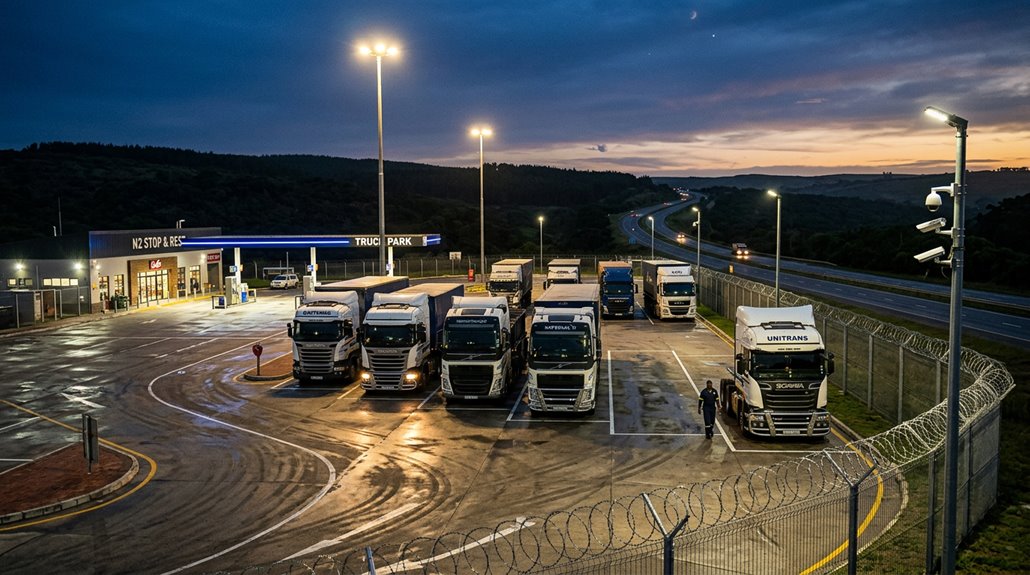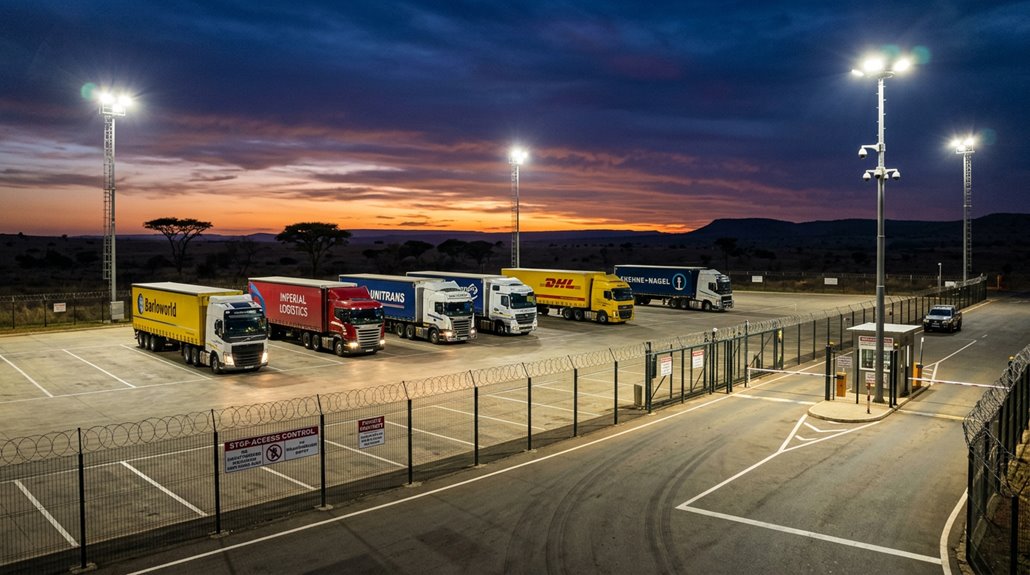
The N3 corridor doesn’t forgive complacency, and neither should you. While unprotected fleets bleed cargo to night-time theft, savvy operators slashed overnight losses by 30% simply by refusing to compromise on where their trucks rest. The difference wasn’t luck. It came down to five specific security benchmarks, including 2.4-metre perimeter fencing and round-the-clock yard surveillance, that separate a facility that merely looks secure from one that actually is. Your driver’s safety and your cargo’s survival hinge on standards most operators overlook entirely. Here’s what actually matters.
Choose Lorry Stops Along Major Freight Corridors
Because long-haul routes carry high freight volumes, you should prioritise truck stops located directly on major corridors like the N1, N2, and N3.
You join a united community of transport operators when you rely on these essential arterial links. Finding safe truck parking areas along primary routes keeps your drivers protected, connected, and moving efficiently between industrial zones and maritime ports. Facilities like Lemba Truck Stop serve as a strategic hub on the N1 freight corridor to keep commercial vehicles moving safely. Choosing stops that also offer 24/7 truck services such as tyres, towing, repairs, and secure monitored parking further reduces risk and keeps your fleet operational.
Targeting secure truck stops guarantees that your fleet shares established staging hubs rather than isolated lay-bys.
Prioritise secure truck stops to guarantee your fleet uses established, protected staging hubs over isolated, vulnerable lay-bys.
These locations deliver measured results for our national logistics network:
- They cut dangerous shoulder queuing near busy bottlenecks and weighbridges.
- They advance overall truck parking safety across heavily travelled trade routes.
You will achieve a great result by keeping rigs aligned with standardised corridors.
Check for Manned Access and Perimeter Fencing
When you assess an overnight staging site, you must confirm that manned access points control the entry queue.
You join a professional community that values driver safety and cargo protection. Dedicated security teams screen every vehicle, contractor, and visitor before granting site entry. They log movements carefully, creating a documented chain of custody that keeps everyone secure. Deploying PSIRA-registered security guards ensures that vehicle movement and entry gates meet recognised operational standards. For example, partnering with sites supported by 24/7 truck services helps ensure that any security issue or mechanical problem can be dealt with immediately, keeping lorries road-ready and reducing downtime.
Prioritise these lorry parking factors when choosing verified safe truck parking areas SA operators trust:
- Staffed security gates that enforce strict visitor logs and challenge credentials.
- Strong mesh perimeter fencing built to a minimum height of 2 metres.
- Anti-climb barriers, including razor wire topping and buried lower fence sections.
- Mechanised sliding gates synchronised with regular foot patrols along the boundary.
Verify Active 24/7 CCTV and Yard Lighting
Solid boundary fences keep out intruders, but you also need unyielding electronic eyes across the entire staging bay.
You join a professional community of operators when you choose facilities with verified 24/7 high-definition CCTV coverage. You must confirm uninterrupted recordings, smart zoom capabilities, and night-capable cameras that monitor blind spots. This aligns with government efforts implementing a coordinated National Truck Stop Framework to standardise security and facility management across the country.
You should review the yard’s active security integrations:
- Operators maintain 24-hour live camera feeds across gates, lanes, and fences.
- High-mast floodlights brighten parking rows and fuel points without dark gaps.
- Backup generators protect visibility during regional power interruptions.
“Active surveillance protects our shared freight network,” notes one safety specialist.
You gain peace of mind alongside your fellow transport professionals because trained guards actively watch these systems to stop intrusions instantly.
Inspect Driver Ablution and Rest Facilities
While strong perimeter security shields your cargo, driver recovery requires clean, fully functional ablution blocks. You join a professional community that values driver wellness when you choose stops with high hygiene standards. Some premier stops even provide access to onsite wellness clinics for routine health checks and driver education.
Long-haul operators achieve great results by verifying essential amenities before booking overnight stays. Quality facilities refresh team members and reduce fatigue across South Africa’s freight corridors:
- Clean toilets offer running water, functional soap dispensers, fast-draining floors, and intact door locks.
- Well-lit entrances provide separate male, female, and mobility-accessible facilities close to driver staging zones.
- Reliable 24-hour shower blocks deliver consistent hot water, sometimes with a fee for non-overnight users.
- Quiet sleeping rooms give operators dedicated, well-managed spaces for uninterrupted rest away from communal noise.
These shared welfare features protect everyone on the road.
Ensure Designated Lorry Parking Bays and Turning Space
Because heavy vehicles require substantial clearance, you can’t park long-haul rigs in general parking areas. You belong to a professional community that values roadway order and legal compliance. By-laws restrict heavy vehicles to marked bays to avoid municipal fines. Proper facilities display clear “truck parking only” signs, welcoming you into dedicated, secure spaces. Under local regulations, the registered owner is deemed responsible for any contraventions of parking rules. Facilities that offer secure parking often work closely with expert mechanical lorry repairs providers to help minimise downtime if a vehicle develops a fault while parked.
Heavy vehicles require dedicated bays to ensure roadway order, maintain legal compliance, and protect your fleet from costly municipal fines.
These facilities provide key design benefits:
- Turning templates maintain a 1.0 m clearance from fixed obstructions.
- Safe circulation limits reversing distances to 20 m maximum.
- Generous exit lanes measure between 4.0 m and 4.5 m wide.
Standard 2.5 m by 5.0 m car spaces cause severe damage. Quality stops use turning circles instead of tight hammerheads.
Operators feel delighted with these orderly designs, ensuring safe travels for your fleet.